A sustainable future: KVK and the CO₂ Performance Ladder
- Edited 21 September 2026
- 2 min
- Sustainability
KVK is working towards a sustainable future. One of the ways we do this is by reducing our CO₂ emissions. We use the CO₂ Performance Ladder to do so: a system that helps governments and businesses to measure and reduce their CO₂ emissions. KVK has level 3 certification on the CO₂ Performance Ladder.
Every decision we make, big or small, affects the world around us. As a public service provider, we have a responsibility to make that influence as positive as possible. Not only towards entrepreneurs, but also towards our client, (network) partners, suppliers and our employees. That is why KVK is striving for climate-neutral business operations in 2030.
What is the CO₂ Performance Ladder?
At KVK, we tackle our CO₂ emissions using the CO₂ Performance . This system helps organisations measure and reduce their CO₂ emissions, also known as the CO₂ footprint. The CO₂ Performance Ladder consists of 5 levels. The first 3 levels focus on reducing the CO₂ emissions of one's own organisation. Levels 4 and 5 also deal with emissions outside the organisation, such as those of suppliers and customers. If you meet the requirements of a level, you receive a certificate for that level. Each year, certified organisations are reassessed by an independent and accredited party.
In 2025, KVK achieved level 3 certification on the Performance Ladder. We focus on reducing CO₂ emissions within the organisation first. In doing so, we look critically at the energy consumption of the KVK locations, our vehicle fleet, and our business travel.
Our CO₂ footprint
To calculate our CO₂ footprint, KVK uses the Greenhouse Gas . This is the most widely used method worldwide to map the emissions of organisations. As a result, we know exactly what KVK's CO₂ footprint is: 1,157 tonnes in 2025. That figure is based on total emissions from all KVK locations and business travel.
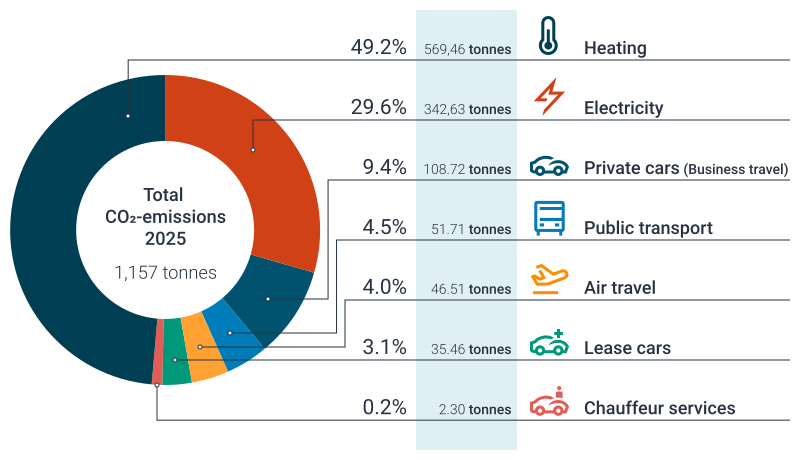
Calculations show that 49.2% of our total CO₂ emissions come from heating. Our premises are mainly heated using natural gas, but some sites use district heating or electric heating systems, such as heat pumps. Electricity accounts for 29.6% of total emissions. Electricity consumption includes lighting, ventilation, and the use of IT equipment at the KVK sites. In 2025, 7 out of 15 KVK sites were using green electricity from the Netherlands.
Business travel accounts for 21.2% of our CO₂ emissions. The majority of this is due to business travel by private car, as shown in the figure above. Public transport accounts for 4.5% of the total, and fuel consumption by leased cars accounts for 3.1% of the total. Business air travel by KVK staff accounts for 4% of the total. Under the Central Government collective labour agreement (CAO Rijk), staff may only travel by air if the train journey takes longer than 8 hours, or is more than one and a half times as long as the flight.
Getting to work
Now that we know how much CO₂ we emit, it is time to take action. That is why we have drawn up a CO₂ policy with clear targets and measures. For example, we are trying to switch to green electricity from the Netherlands at our sites and are implementing additional energy-saving measures. These include upgrading the lighting and reducing unnecessary electricity consumption by appliances. We also have a sustainable transport policy. Through this, we encourage staff to use public transport or cycle to the office and to business appointments more often. You can find more information about the specific measures we are taking in the action plan.
- PDF document
- 16 pagina's
- 1,45 MB
- 28-07-2026
Every year, we go through the steps of the CO₂ Performance Ladder again. We collect and monitor data on our footprint, assess whether we have achieved previous reduction measures, and look at what new measures we can take to further reduce our emissions. This is how we continue to work towards sustainable operations.
Every 6 months we produce a report showing our progress on our CO₂ reduction targets and measures.
- PDF document
- 10 pagina's
- 604,68 KB
- 28-07-2026