KVK Trend Report Q2 2026: More starters in 10 out of 12 provinces
Strongest increase in Groningen and Drenthe
- 23 July 2026
- 2 min
- Press articles
The number of new businesses in the Netherlands continues to grow. In the second quarter of 2026, the number of starting businesses rose by 4.8 per cent compared with the same period a year earlier. The number of closures fell by 9.2 per cent. Also, fewer businesses went into liquidation. It is striking that in 10 of the 12 Dutch provinces, more businesses were started than a year earlier. The strongest growth was seen in Groningen and Drenthe. On 30 June, more than 2.6 million businesses were registered in the KVK Business Register.
Following the rise in the first quarter of 2026, the number of starters continued to increase in the second quarter compared with the same period a year earlier. In virtually all provinces, there were more starters per 10,000 inhabitants. The strongest growth was seen in Groningen (+14%) and Drenthe (+12%). Only in Zeeland and North Brabant did the number of start-ups fall slightly, by 2%.
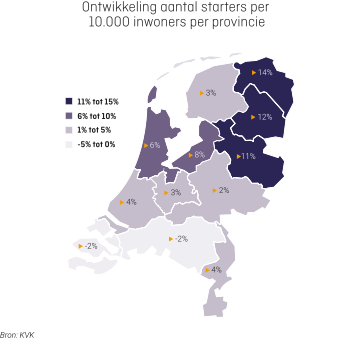
Number of starters per province
Trend in the number of starters per 10,000 inhabitants by province.
Entrepreneurship is spreading ever more widely across the Netherlands
Erik Stam, professor at Utrecht University: “It is striking that the growth in the number of starters is spreading across the whole of the Netherlands. A particularly strong rise can be seen in the north-east, especially in sectors such as IT, specialised provision of services, construction, and education. Groningen is emerging as a new economic driver in this regard.”
Noord-Holland has the most starters per inhabitant
With 43 starters per 10,000 inhabitants, Noord-Holland once again had the highest number of new businesses per inhabitant. Zuid-Holland and Flevoland followed with 35 start-ups per 10,000 inhabitants. In Drenthe, this figure was the lowest, at 23 start-ups per 10,000 inhabitants. Measured by the total number of starters, almost a quarter come from Zuid-Holland (24%), followed by Noord-Holland (23%). Of all starters, 79% are zzp'ers (self-employed professionals without staff).
Number of business closures continues to fall
The number of business closures fell by 9.2% compared with the second quarter of 2025. This continues the downward trend seen in the first quarter of this year. In all provinces, the number of business closures per 10,000 inhabitants was lower than a year earlier. The sharpest decline was seen in Flevoland (-17%) and Drenthe (-15%). As in previous quarters, the highest number of business closures was in Zuid-Holland and Noord-Holland. Noord-Holland also had the highest number of business closures per 10,000 inhabitants. This figure was lowest in Drenthe.
Fewer bankruptcies
The number of bankruptcies also fell. In the second quarter of 2026, 813 businesses went bankrupt. A year earlier, the figure was 932. This represents a fall of 12.8%.
Growth mainly in provision of services
Most starters were established in the provision of professional services sector (17 per cent), followed by retail (14 per cent) and construction (11 per cent). Although the retail sector still accounts for a large number of new businesses, the number of starters in this sector fell compared with a year earlier.
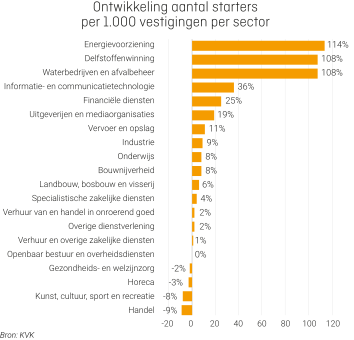
Trend in number of starters per sector
Trend in the number of starters per 1,000 establishments by sector.
Positive trend, challenges remain
More starters, fewer businesses closing down, and fewer bankruptcies are ensuring that the number of businesses in the Netherlands continues to grow. This is a positive development. At the same time, many entrepreneurs are still facing economic uncertainty and a shortage of staff.
Renewed optimism among business owners
“The latest figures from the KVK reveal a striking degree of optimism. After the number of businesses closing down rose and the number of starters fell last year, we are now seeing more starters again, along with fewer closures and fewer bankruptcies. The increased stability in domestic politics seems to be outweighing the geopolitical uncertainty,” says Stam.
KVK Trend Report second quarter 2026 (PDF, in Dutch)