Extended producer responsibility (UPV): what is it?
- 8 March 2024
- Edited 6 March 2026
- 2 min
- Sustainability
- Managing and growing
- Danitsja Kallendorf
Are you an importer or producer and are you the first to market your product in the Netherlands? For certain product groups, you are responsible for your products when they are discarded or used up. You have what is called extended producer responsibility (UPV).
Extended producer (uitgebreide producentenverantwoordelijkheid UPV) ensures that manufacturers remain responsible for their products even after they are no longer used. If the UPV applies to your product, you will face additional costs and rules. Such as the obligation to provide and pay for collection and recycling. The UPV encourages producers to make more sustainable choices at the beginning of the chain. For instance, by choosing materials that last longer.
Who does the UPV apply to?
The UPV applies to producers who are the first to place a product on the Dutch market. This includes importers, manufacturers, and foreign suppliers. Say, you import clothes from China. The UPV applies to you in this case, because you are bringing the clothes onto the Dutch market for the first time. If you buy it from a business in the Netherlands, you have no UPV obligations.
If you join a producer oprganisation, it will take care of the UPV obligations for you.
Which products are subject to UPV?
Do you manufacture or import products from these product groups? And do you sell the products in the Netherlands? Then you must comply with the UPV rules:
- Car (in Dutch)
Applies to manufacturers and importers of car tyres and tyres for trailers. - Cars
Applies to manufacturers and importers of cars weighing up to 3,500 kilograms. - Batteries and accumulators
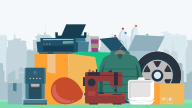
Applies to manufacturers and importers of batteries or accumulators. - Electrical equipment
Applies to you if you manufacture or import electronic or electrical equipment. This concerns equipment up to 1,000 volts (alternating current) or 1,500 volts (direct current). - Textiles
Applies to producers and importers of clothing and household textiles, such as tea towels and duvet covers. - Packaging
Applies to you if you produce or import more than 50,000 kilograms of packaging. - Single-use disposable
Applies to producers and importers of single-use plastic, such as plastic bags, packaging and balloons. The UPV also applies to you if you have your name, brand, or logo placed on single-use plastic. For example, a plastic bag or packaging. - (in Dutch)
Applies to you if you produce or import mattresses. This includes single and double mattresses and toppers, children's mattresses and baby mattresses. - Fishing (in Dutch)
Applies to you if you produce or import fishing gear containing plastic. Examples include fishing nets and fishing lines. - Insulation (in Dutch)
Applies to producers and importers of various types of insulation glass. - Paper and (in Dutch)
Applies to you if you produce or import paper or cardboard. (This UPV does not apply to packaging.)
What does a producer organisation do?
There are producer organisations for many sectors. These help businesses to comply with the UPV requirements. If you join such an organisation, it will take care of the UPV obligations for you. This includes collecting and recycling the products and reporting to the government. You pay a waste contribution for this. This is usually an annual amount. How much you pay depends on how many products you place on the market.
Generally binding agreements (AVV)
It may be mandatory to join a producer organisation. This is the case if there is a generally binding agreement (AVV). Under such an AVV, all producers and importers contribute to the UPV system. Producers can submit a request for an AVV themselves. Check if there is an AVV for your (in Dutch).