A pension scheme for employees: yes or no?
- Edited 13 February 2026
- 3 min
- Staff
- Managing and growing
- Esther Riphagen

How does a pension work? Is offering it mandatory for employers? And what does the Pension Act mean for you and your employees? Read the answers to frequently asked questions here and find out how to prepare for the new pension rules.
Pension is income your employees receive from reaching retirement age. Most employers (in Dutch) offer a pension scheme as part of the fringe benefits. You help pay for your employees' pensions, allowing them to build up their pensions. Pension expert Pim Adams works at a.s.r. and answers three frequently asked questions about pension schemes.
Want to know immediately how to arrange a pension for your employees? Then take a look at the checklist to offer a pension scheme to your .
1. How does a pension work?
"When building up a pension, employer and employees pay a monthly amount of money, the pension contribution. With this, they save for a supplementary pension that supplements the old-age pension (AOW). When your employee reaches retirement age, the pension institution starts paying out the accumulated pension."
Pension consists of 3 parts:
- State pension from the government.
- Pension that your employees build up through your pension scheme.
- Additional amount your employees save themselves or build up through assets.
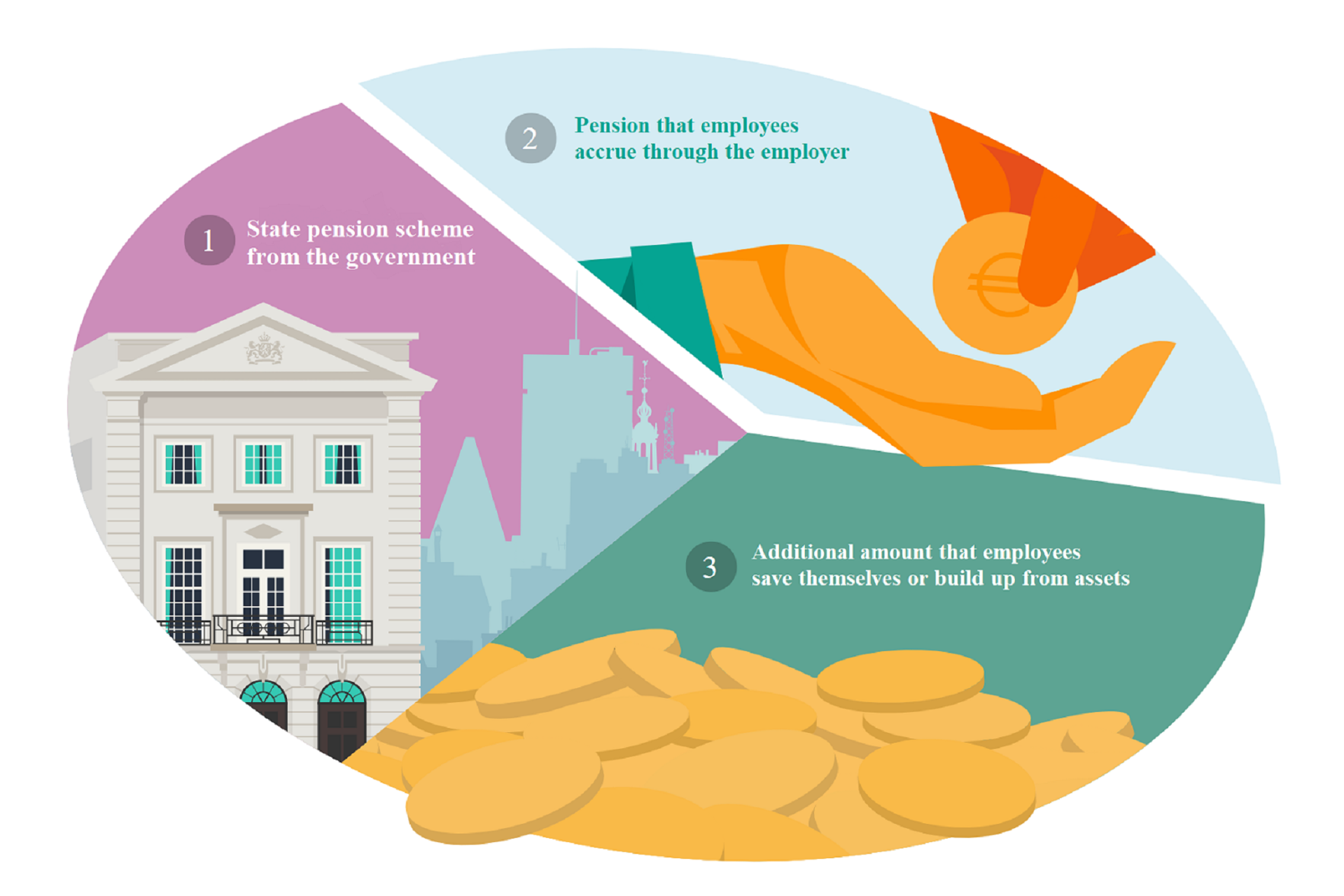
Image of the 3 parts of the pension
This image shows that the pension consists of 3 parts, namely:
- Pension scheme from the government.
- Pension that your employees build up through your pension scheme.
- Additional amount your employees save themselves or build up through assets.
As an employer, you can mean something in the second part, namely offering a pension scheme. If you don't want to offer a pension scheme, you can also think about giving a pension allowance on top of the salary. Like employer Danny van Kampen in his software company Bexter: "All employees get an extra €150 net every month, as a kind of pension allowance. One risk of this allowance is that the employee does not have to put that money aside. If they always spend this on groceries, they may be in for a nasty surprise later in life."
2. Is offering a pension scheme mandatory?
There is no legal pension obligation in the Netherlands for employers and employees. Nevertheless, about 70 % of companies are obliged to offer a pension. This is due to a general binding declaration of an industry-wide pension scheme or a provision in the Collective Labour Agreement (CAO). So, read your CAO carefully. The Pension Federation tool (in Dutch) gives you an indication of which pension fund your company belongs with. The pension fund will then tell you whether you are subject to the obligation.
The actual activities of your company ultimately determine whether you have an obligation through an industry-wide pension scheme. This is done on the basis of your activity code (SBI code) in the Business Register. So, check regularly whether your registration in the Business Register still matches reality, and adjust it if necessary.
3. What is the division of pension contribution between employer and employee?
"About half of the employers also let the employee contribute themselves. Often, the employer pays two-thirds and the employee one-third," says Adams.
How do you determine the pension contribution? "The monthly employer and employee contribution, also known as the pension contribution, is determined by the gross annual salary and the pension base. The pension base is that part of the salary on which a person accrues pension."
There are 2 rules of thumb:
- You determine the pension accrual percentage on the amount of the pension base, and therefore not on your employee's entire salary. You calculate the pension base as follows. You take your employee's annual salary, which is, for example, €39,172. From this you deduct the AOW threshold, also known as the AOW franchise. That is €19,172 (2026, minimum set by the Tax Administration based on the average pay scheme). This leaves a pension base of €20,000. Over this amount, you determine the pension accrual percentage. This is subject to a maximum of €137,800 (2026) pensionable salary on which you can accrue pension with tax benefit.
- There is a maximum percentage you can deposit. This depends on the scheme the employee is covered by.
Adams says that on average, his clients (of Doenpensioen from a.s.r.) choose a pension scheme of 1% to 14% of pensionable pay.
Calculation example pension contribution distribution
Your employee earns €39,172 and a pension base of €20,000 remains. On average, the pension premium will then be between €200 and €2,800 per year. If, as an employer, you pay two-thirds of this premium, your annual contribution for this employee will be between €133 and €1,866. The above calculation applies to one employee, but you pay contributions for all employees. If you have 10 employees, a similar calculation and contribution will apply to all ten employees, income-dependent of course. Assuming the above calculation and ten employees with equal salaries, the employer's annual premium is between €1,330 and €18,660.
No obligation to offer a pension scheme
Are you not obliged to offer your employees a pension? In that case, you can still offer a pension scheme. You do this by joining a general pension fund or through a pension insurance with a pension insurer. For more information, see step 4 in this step-by-step . In addition, contact an independent pension adviser. You can find one through the professional organisation for independent pension advisers (in Dutch) or trade association (in Dutch).
New Pension Act
Does your business not have a collective labour agreement (CAO)? The new Pension Act states that you will need to make new agreements with your employees and pension provider. There will be new rules on the premium in the Pension Act. Pension providers have until 1 January 2028 to make new arrangements with you and your employees and to implement them. Do not wait for your pension provider to contact you, but take action yourself. Make new pension arrangements with your employees in good time. And draw up a (mandatory) transition plan together with the pension administrator.