The sustainable reporting directive CSRD: what does it mean for you?

- Background
- Edited 23 December 2025
- 3 min
- Managing and growing
- Sustainability
The Corporate Sustainability Reporting Directive (CSRD) is a European directive that requires large companies to report on sustainability. Do you do business with such a company? Then they may ask you to produce a sustainability report as well.
Update
The European Commission has issued a proposal to make CSRD easier for businesses. The proposal affects which businesses are required to report, how they report, and how businesses can request information. This proposal will also affect CSRD rules in the Netherlands. As soon as more is known, you can read about it in this article.
How does your business impact the world? Since the beginning of 2024, many large organisations are required to answer that question in their Corporate Sustainability Report. The report needs to contain information on how a company affects the environment and human rights, for example. This is laid down in the European Corporate Sustainability Reporting Directive (CSRD). In the Netherlands, the minister responsible has sent a bill for this purpose to the House of Representatives.
The rules apply from 2024 to businesses that were already required to include a non-financial in their annual report. From 2027, other large businesses will also have to prepare an annual sustainability report.
The CSRD: when and for whom?
Since 2024, the CSRD applies to large companies. A large company is legally defined as a company that meets at least 2 of these 3 criteria:
- Over 250 employees
- Over €50 million annual turnover
- More than €25 million on the balance sheet
For SMEs listed on the stock exchange, the CSRD will take effect on 1 January 2028.
Sustainability reporting for SMEs
Even if your business is not yet required to report, you may be asked questions about sustainability. This is because large businesses are also required to provide information on the sustainability of their suppliers in their reports. So you can expect questions from larger businesses that buy your products. For example, about how your product is made and by whom. And whether that is done in a fair way. The European Sustainability Reporting (ESRS). state what information must be included in the report.
What should I do as an SME?
Make sure you can answer your customers' questions. Otherwise, they may choose to do business with a competitor who can. Where do your products come from, what materials do you use, and how sustainable are they? Ask your supplier or importer questions you cannot answer yourself. There are also online tools, such as the CSR Risk , which you can use to check products and procurement.
More information about the CSRD
On the Social and Economic (SER) website you will find more information and frequently asked questions about .
Voluntary reporting standards for SMEs
There are separate standards for SMEs that wish to report voluntarily, the Voluntary reporting standards for (VSME ESRS). These are simpler than the standards for large businesses. Separate standards will also be introduced for listed SMEs, the ESRS for listed .
The standards are not yet final and may still change. Further information about these standards will be published on this page as soon as it is available.
European Sustainability Reporting Standards (ESRS)
The ESRS consist of 2 sets of standards:
- Standards for all sectors: for all businesses covered by the CSRD directive.
These include the general standards (ESRS 1 and ESRS 2) and the 10 standards divided into the topics environmental, social, and governance. - Standards by sector: these are not yet known.
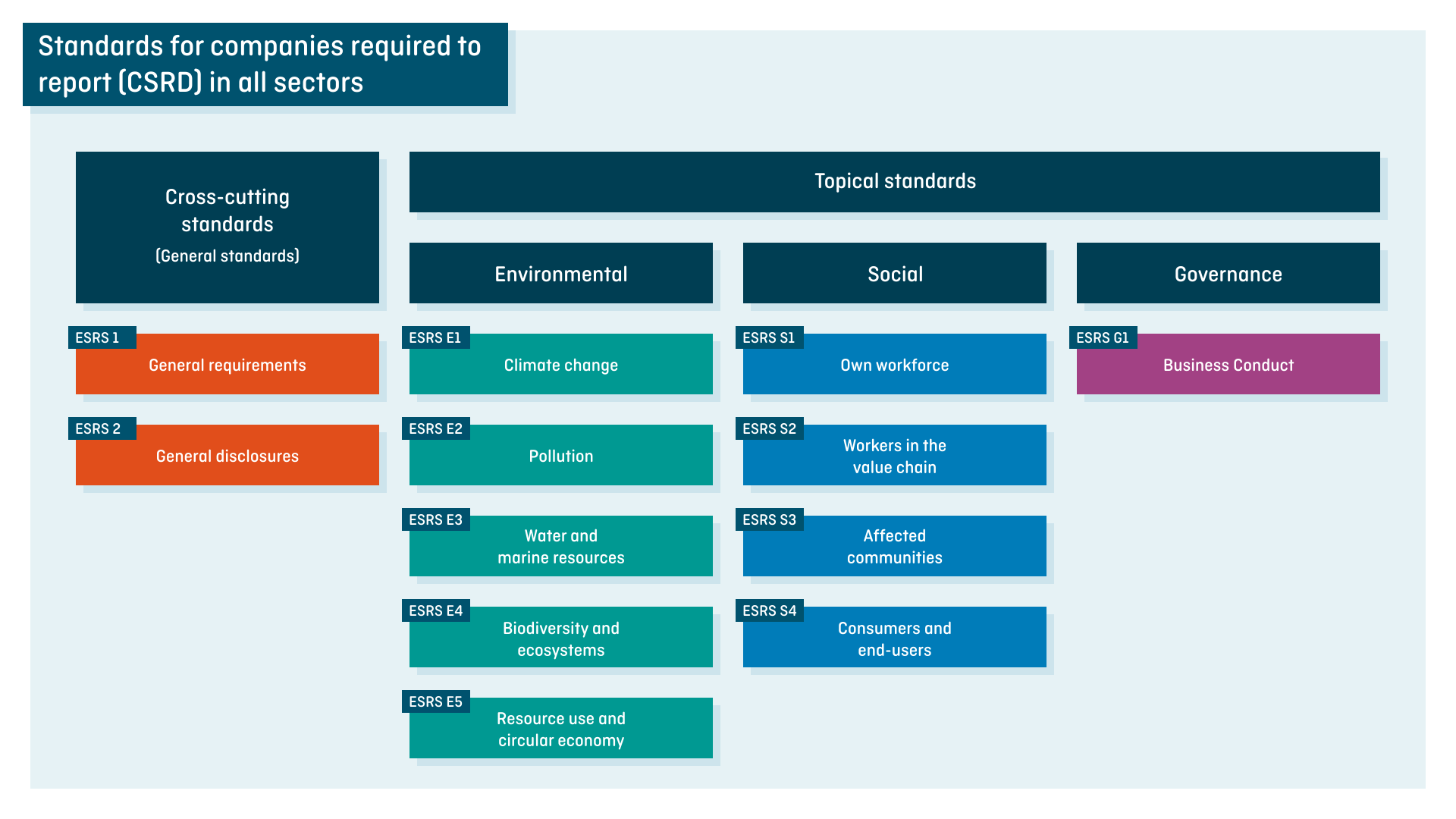
ESRS Standards
- The illustration shows the 12 ESRS standards.
- These 12 standards apply to companies that have to comply with the CSRD within all sectors.
- The 2 general standards (also called cross-cutting standards) impact the 10 topical standards. The 2 general standards are:
ESRS 1, General requirements.
ESRS 2, General disclosures (requirements on what and how you have to report). - The 10 remaining standards deal with one of 3 topics: Environmental, Social, and Governance.
- The following 5 standards apply to the topic Environmental:
ESRS E1, about climate change
ESRS E2, about pollution
ESRS E3, about water and marine resources
ESRS E4, about biodiversity and ecosystems
ESRS E5, about resource use and circular economy - There are 4 standards that apply to the topic Social: ESRS S1 is about the own workforce
ESRS S2, about workers in the value chain
ESRS S3, about affected communities
ESRS S4, about consumers and end-users - There is 1 standard in the topic Governance:
ESRS G1, about business conduct
CSDDD: additional rules on sustainability
The EU wants businesses to do more than just report on their sustainability performance. Businesses must also work to reduce their negative impact on people and the environment.
This is what the European legislation Corporate Sustainability Due (CSDDD) is about. The law obliges businesses to detect, address, and counteract problems and illegal activities. As with CSRD, the introduction of CSDDD will be done in phases, with the largest businesses being first. The first businesses are expected to have to comply with CSDDD rules by 2026.
FAQ
First, do all you can to get the information. If that does not work, you can use estimates. You need to be able to explain what your estimates are based on. For example, use emission values of comparable businesses in your sector.
Yes, it does affect the way you report. Subsidiaries do not have to report separately if the parent company reports at the group level. That includes your company's data. Be sure to provide your parent company with the required information.