Zero-emission zones: what do they mean for your deliveries?
- Edited 14 July 2026
- 5 min
- Sustainability

Do you often deliver goods in the city centre? And do you do so by van or truck? Make sure you will still be allowed to enter the city centre now that zero-emission zones have been introduced. These are areas that only vans and trucks that do not emit harmful substances are allowed to enter.
Delivery van emission class 5
From 1 January 2027, you will no longer be allowed to enter zero-emission zones with a delivery van in emission class 5. However, you can apply for an exemption for up to 12 days a year. Use the zero-emissions licence plate (in Dutch) to find out whether your vehicle is permitted to enter a zero-emission zone.
The zero-emmission zone rules are part of the Dutch government’s Climate (in Dutch). This broad national strategy aims to reduce greenhouse gas emissions.
What are zero-emission zones?
Zero-emission zones, also known as emission-free zones, are areas in municipalities you can only enter if your van or truck does not emit any harmful substances. Electric vehicles and hydrogen-powered transport are always allowed to enter the zones.That means you cannot enter these zones with an older van or truck running on diesel, petrol, or LPG. If you have a newer vehicle registered no later than 2024, there is a transitional arrangement (see graphic below).
Between 2025 and 2030, 29 (in Dutch) will introduce zero-emission zones (ZE zones). The effective date varies by municipality. So, make sure you know which date (in Dutch) in the municipality or municipalities where you work or visit regularly.
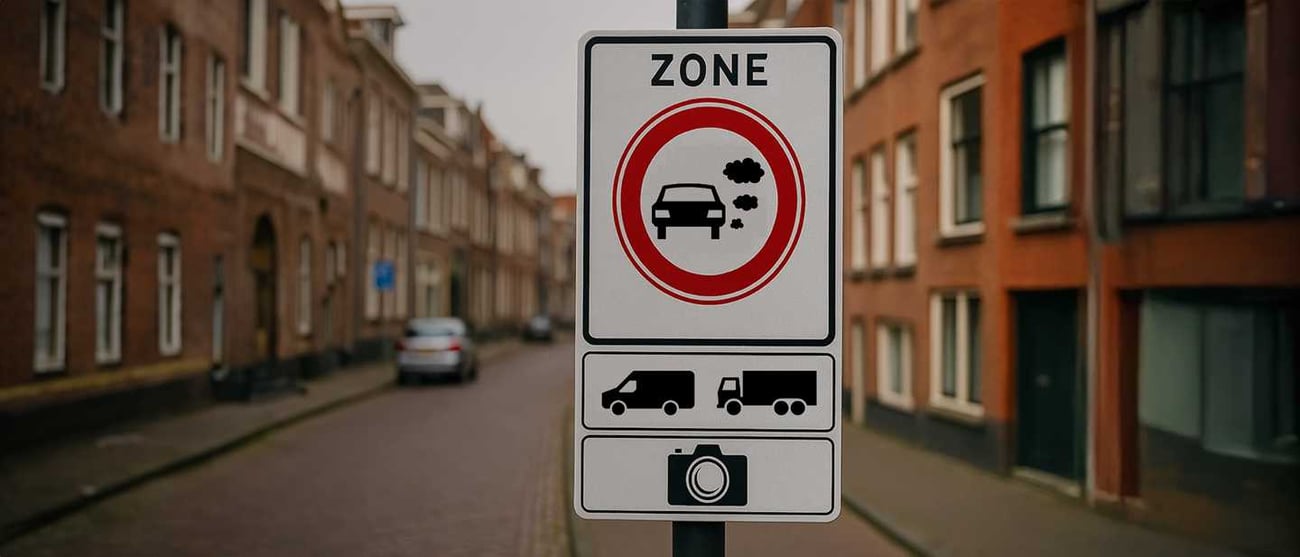
The new road sign for zero-emission zones
New road sign
Since 2026, there has been a new road sign for zero-emission zones and environmental zones. The rules remain the same. The sign indicates that you are entering such a zone. It also shows which vehicles you are not allowed to enter the zone with.
Can you still enter the city centre with your company van in the future?
Who do the rules for zero-emission zones apply to?
Polluting vans and trucks are not allowed in the zero-emission zones. This includes box trucks, tipper trucks, and semi-trailer trucks. Zero-emission zone entry rules apply to both existing and new vehicles. Municipalities that have introduced a zero-emission zone will not give a fine but only a warning for at least the first 6 months.
Not for passenger cars
The rules for zero-emission zones do not apply to passenger cars, but in Amsterdam, Arnhem, The Hague and Utrecht there are other environmental zones for passenger cars.
To ensure you have time to prepare, there is a transitional arrangement. This arrangement allows some existing vans running on diesel, petrol, or LPG to enter the ZE zones for a little longer. The entry rules differ for vans and trucks. Check the rules below to see if your van or truck is covered by the transitional arrangement.
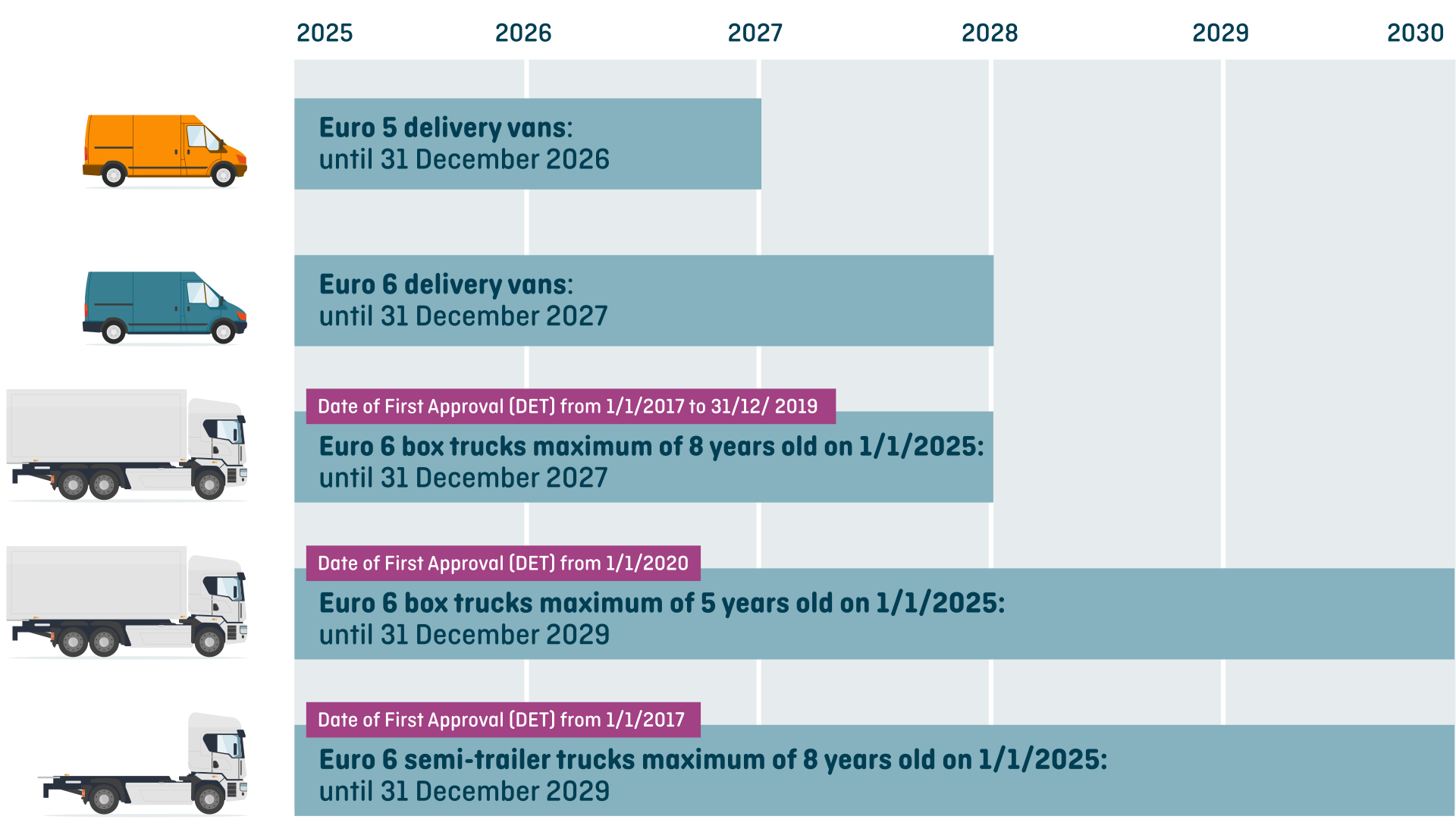
The illustration shows the exceptions for different types of vehicles.
- Euro 5 delivery vans until 31 December 2026
- Euro 6 delivery vans until 31 December 2027
*Update April 2025: Commercial vehicles with emission class 6 are now permitted to enter zero-emission zones until 31 December 2027. The government intends to extend this by one year, until 31 December 2028. - Date of First Approval (DET) from 1/1/2017 to 31/12/ 2019
Euro 6 box trucks maximum of 8 years old on 1/1/2025: until 31 December 2027 - Date of First Approval (DET) from 1/1/2020
Euro 6 box trucks maximum of 5 years old on 1/1/2025: until 31 December 2029 - Date of First Approval (DET) from 1/1/2017
Euro 6 semi-trailer trucks maximum of 8 years old on 1/1/2025: until 31 December 2029
Van entry rules
For existing vans, access to the ZE zone depends on the emission standard. The emission standard defines how clean your vehicle is. The higher the emission standard, the lower the emissions of harmful substances such as CO2 and particulates. Want to know whether your van can enter a zero-emission zone? Check with the zero-emissions licence plate (in Dutch).
All new vans registered from 1 January 2025 must be zero-emission. So, if you buy a van in or after 2025, this vehicle must not emit any harmful substances. Other rules are:
- Vans with an emission standard Euro 4 or lower do not have access to the ZE zones.
- Vans (registration year 2024 or earlier) with an emission standard Euro 5 have access to the ZE zone until 1 January 2027.
- Vans (registration year 2024 or earlier) with an emission standard Euro 6 have access to the ZE zone until 1 January 2028. Note: for vans with emission standard 6, the rule may be postponed for a (in Dutch).
There are a few exceptions. Certain vehicles are allowed to enter the zones despite the above rules. These include:
- Vintage cars. These are vehicles 40 years or older.
- Vehicles that are wheelchair accessible.
- Vehicles that have been modified for €500 or more to accommodate a disability.
For these types of vehicles, you will automatically receive an exemption based on your registration number.
Temporary exemption
Does your vehicle not automatically receive an exemption? Then you can apply for an (in Dutch). For example, you can apply for an exemption if your new electric van has a long delivery time. From January 1, 2026, you can also apply for an exemption if there is no way to charge your vehicle from a full power grid. Read all the exemption (in Dutch)
Truck entry rules
For existing trucks, access to the zones depends on the Date of First Admission (DET). This is the date your vehicle was registered. All new trucks registered from 1 January 2025 must be emission-free to enter ZE zones. Do you have a hybrid lorry? If so, you can get an (in Dutch) if you drive solely with electric power in ZE zones.
In addition, the following rules apply to box or tipper trucks and semi-trailer trucks:
- Euro 6 box or tipper trucks with a Date of First Approval (DET) between 1 January 2017 and 31 December 2019 will have access to the ZE zones until 1 January 2028.
- Euro 6 box or tipper trucks that are up to 5 years old (from DET) on 1 January 2025 will have access to the ZE zones until 1 January 2030.
- Euro 6 semi-trailer trucks that are up to 8 years old (from DET) on 1 January 2025 will have access to the ZE zones until 1 January 2030.
As with vans, there are also exceptions to the entry rules for (in Dutch). For example, for vintage trucks, fairground and circus trucks, or removal vans.
Emission-free transport: what are the options?
Is your current van or truck no longer allowed to enter zero-emission zones? Then look at other options for transport. Can you invest in an electric van? Or switch to other inner-city transport? Perhaps a cargo bike or light electric vehicle (LEV) is an option for you. You could also explore whether a city hub suits you. A city hub is a collection point on the edge of the (in Dutch), outside the ZE zone. Companies can bring their goods here. A transport company then brings the packages to the city centre in emission-free vehicles.
Subsidies and schemes
If you switch to zero-emission transport, you can take advantage of sustainability subsidies and tax breaks. Municipalities with zero-emission zones also offer support to businesses wishing to switch to clean transport. This might include a free consultation, a grant towards the scrapping of old delivery vans, or the chance to try out different modes of transport for free.Ask your municipality about the possibilities or check your options at (in Dutch).