Solve your business debts: these are the options

- Gé Sletterink
- How to
- Edited 10 February 2026
- 6 min
- In trouble
- Rules and laws
Do you have debts you can no longer pay? You have several options to deal with your debts. For example, an amicable settlement, the Natural Persons Debt Rescheduling Act (WSNP), the Court Approval of a Private Composition Act (WHOA), bankruptcy, and suspension of payment. Read which scheme suits your situation and what this means for you.
The debt flowchart (see image) offers you an overview of the different routes. It is a simplification of the reality. Below the image you can see a more detailed explanation of what the concepts and situations in the flowchart mean.
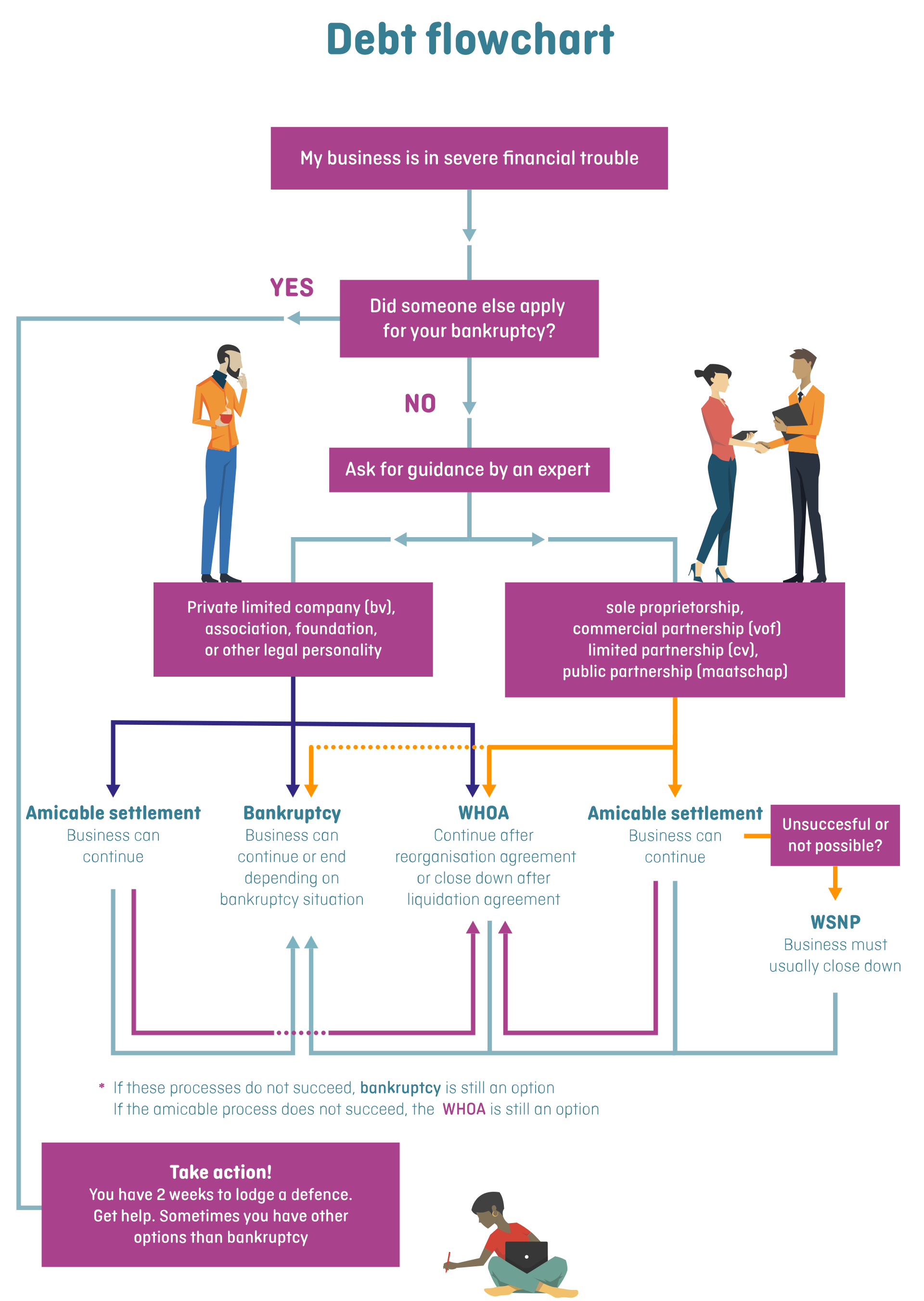
Does your business have problematic debts? Has someone else filed for your bankruptcy? If so, take action. You have 2 weeks to file a defence. Seek help. Sometimes a settlement is an option. If not, seek help for guidance. A BV, association, foundation, or other legal entity may look at an amicable settlement, WHOA, or bankruptcy. A sole proprietorship, general partnership, limited partnership, or professional partnership can look at an amicable settlement, WSNP (if an amicable settlement is not possible or successful), WHOA, or bankruptcy.
What are problematic debts?
You have problematic debts if you are no longer able to meet your financial obligations in the short and long term. This situation is also known as insolvency.
Seek help as quickly as possible
In a problematic financial situation, you can get help from, for example, a bookkeeper, accountant, or lawyer. Or contact the KVK Advice Team for information, brief advice, or referral. The Entrepreneur can also advise and coach you.
Has someone else filed for your bankruptcy?
Has someone filed for your ? You can object to the bankruptcy petition. You have to prove with a statement of defence that you have not stopped paying. In the court summons, you can read how long you have to deliver the statement of defence to the court. If the judge declares you bankrupt, you have 8 days to appeal against the decision.
What legal structure do you have?
In addition to your financial situation, the legal structure of your company also influences what possibilities are open to you for debt settlement. The legal forms can be divinded into 2 groups:
- Natural persons: Eenmanszaak (sole proprietorship), VOF (general partnership), CV (limited partnership), maatschap (professional partnership).
- Legal entities: BV (private limited company), NV (public limited company), vereniging (association), coöperatie (cooperative), onderlinge waarborgmaatschappij (mutual insurance association), and stichting (foundation).
Below you can read which process is suitable for which legal structure.
1. Amicable settlement
An amicable settlement is a voluntary arrangement that is agreed outside the court. You can then continue with your business. Yin this process, you make agreements with your creditor(s) yourself or through a debt counsellor. You pay back as much debt as possible within 18 months. If any debt remains after 18 months, it can be waived by the creditors.
| Amicable settlement in brief | |
| For whom | Natural and legal entities. |
| Costs | If you enter into anamicable process through the municipality or an organisation engaged by the municipality, the municipality will bear the costs for the process. If you seek advice from a commercial debt relief organisation, there may be costs involved. |
| What if the amicable settlement fails or is not possible? | Then you can still apply for the WSNP or bankruptcy yourself. |
2. Natural Persons Debt Rescheduling Act (WSNP)
The Natural Persons Debt (Wet Schuldsanering Natuurlijke Personen, WSNP) is a statutory debt restructuring process to resolve your debts. The WSNP is only for natural persons. You ask the court in your place of residence for admission to the WSNP. Conditions apply. The municipality can help you with a statement showing that an amicable settlement has not been successful. Such a statement is a condition for admission to the WSNP.
If the judge admits you to the WSNP, the court will draw up a plan to restructure your debts. This plan states the amount that you must repay in 18 months. You will then be assigned an administrator. Often the administrator will close down your business. If you follow the WSNP process correctly, you no longer have to pay any remaining debts at the end of the agreed period.
WSNP in brief | |
| For whom | Natural persons. Even if a creditor petitions for your bankruptcy, you can request the court to convert it to WSNP. |
| Costs | The costs for an administrator are settled in your debt repayment plan. The final amount depends on the complexity of the case. |
| What if the WSNP fails? | If you do not comply with the obligations of the WSNP, the court can declare you personally bankrupt. |
3. Court Approval of a Private Composition (Prevention of Insolvency) Act (WHOA)
The Court Approval of a Private Composition (Prevention of Insolvency) Act (Wet homologatie onderhands akkoord, WHOA) helps companies that are in danger of going bankrupt due to high debts. If bankruptcy is imminent, you can start a WHOA process yourself. Creditors, shareholders, staff representatives, or the works council can also start a WHOA process.
A WHOA process can take 5 to 6 weeks, but can also take several months. There are 2 types of WHOA agreements: a reorganisation agreement and a liquidation agreement. However, the costs for a WHOA route can be a barrier for small(er) self-employed entrepreneurs.
WHOA in brief | |
| For whom | Natural persons and legal entities. |
| Costs | Consultancy costs and legal costs for supervising a WHOA process. For a sole proprietorship, the total costs are estimated at approximately €8,000. For the other legal structures, they will amount come to more than €12,000. Additional audit fees and costs for the appraisal valuation of your assets may be added to this. |
| What if the WHOA fails? | Then bankruptcy follows. |
Video: On the brink of bankruptcy? The WHOA may be your way out
4. Suspension of payment
Suspension of payment (surseance van betaling) is not included in this flowchart, because the success rate of this scheme is highly limited. And usually, bankruptcy follows after this process fails. The WHOA is a better alternative.
You can ask the court for a suspension . If the court grants this suspension, your creditors will not be able to claim their debts for a maximum period of 1.5 years. The court will appoint an . An administrator manages your assets with you and arranges all financial matters.
5. Bankruptcy
is often the last option. You can file for bankruptcy yourself at the court, but someone to whom you owe money can also do this.
The judge determines during a hearing whether the bankruptcy petition is justified. You can defend yourself during the hearing. If the court declares you bankrupt, you can appeal this decision within 8 days of the ruling. Once the bankruptcy is final, you can no longer make use of debt restructuring.
In bankruptcy proceedings, the judge appoints a who takes over all decisions and your financial affairs. The curator makes a payment proposal to the creditors. There are then 2 possibilities:
- The creditors agree to the curator's proposal. This is called a bankruptcy agreement. The creditors will then be paid part of their claim. After the bankruptcy, the creditors cannot enforce payment of the unpaid portion of their claim.
- The creditors of the court do not agree with the curator's proposal. The trustee sells your assets to pay the creditors. After the bankruptcy, creditors can demand that you pay the unpaid portion of their claim.
If you have too few assets to pay the costs of a bankruptcy curator and the administration of the bankruptcy, the bankruptcy ends 'for lack of income'. Your debts still exist. Creditors can still make a claim in the future. Bankruptcy proceedings can take years.
Bankruptcy in brief | |
| For whom | Natural persons and legal entities. |
| Costs | You pay the curator with the money that is still available or comes from your company. For example, by selling your stock and estate. Or by collecting outstanding bills from your debtors. The court determines the curator's salary. The basic hourly rate (in Dutch) of a curator has been set at €275.33 for 2026. |
Video: Bankruptcy? Take action | KVK
Help with financial problems
Do you have problematic debts or are there signs that your business may soon be in trouble? Then contact the KVK Advice Team, your municipality, or a debt assistance agency to talk about your situation and learn more about what options you have to solve your problems. A debt counsellor can help you further.
Getting started with debt
Do you have problematic debts? Talk about it and act as soon as possible. View the step-by-step plan.