Disruption to your business? Consider the costs
- 25 June 2026
- Edited 27 July 2026
- 4 min
- Managing and growing
- Gé Sletterink

A disruption is any situation that prevents your business from operating or delivering as normal. Many entrepreneurs underestimate the costs of a major disruption. They think of it as just being unable to work for a while. But your turnover may stop completely while costs continue to rise. So it is good to think about what a disruption will cost your business.
Examples of a disruption to your business include an IT failure, a power cut, transport problems, or the failure of a key supplier or platform. The effects are immediately reflected in your finances: revenue is lost, but your fixed costs continue as normal. These include rent, wages, subscriptions, and insurance. At the same time, you often have extra costs to fix the problem. For example for emergency solutions or alternatives. And insurance does not cover all your losses.
What are the costs associated with a disruption?
Provision of services: loss of time and missed turnover
When your business is providing services, downtime means an immediate loss of income. If you are not working, you cannot bill for hours and you lose turnover. Work gets pushed back and customers must wait or they cancel their orders. You may also face complaints from your customers if you do not deliver on time. Because your diary is already full, it is difficult to catch up on scheduled work. The loss is often permanent, and your fixed costs keep mounting.
Products and trade: loss of time and value
Do you supply products? Then you are dealing with time and goods. If production or delivery stops, the entire supply chain is disrupted. You will miss out on turnover due to sales stopping, and products may lose their value. If you are unable to deliver on time, your customer may make a claim against you. Alternatively, you may have extra costs for express delivery, alternative sourcing, or using other suppliers. The longer the disruption lasts, the greater the financial loss – especially if products are perishable or time-sensitive.
Production: additional recovery costs and hidden losses
Do you manufacture your own products? If so, a disruption can cause damage to your production process. You will face costs for cleaning, resetting, and restarting your machinery. You may also face hidden losses because you can no longer use semi-finished goods or because products are of inferior quality. This only becomes apparent later.
Internet or power outages
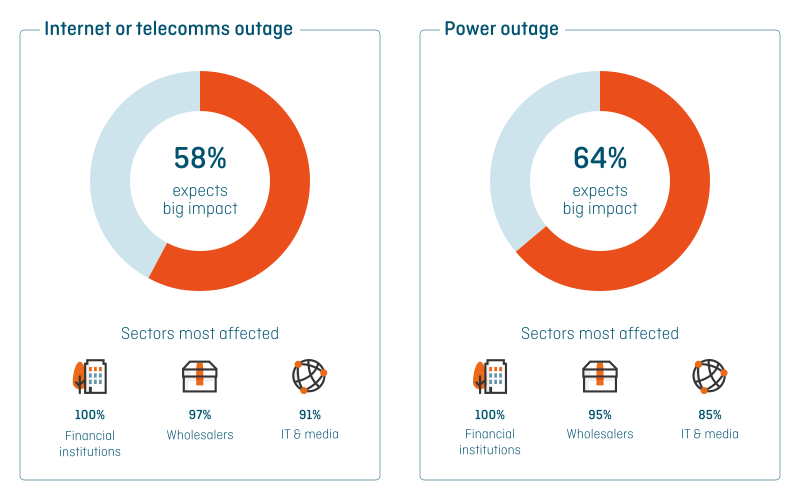
According to entrepreneurs, a power disruption or internet outage has a significant impact on their business.
58% expect a major impact. Sectors most affected:
- Financial institutions: 100%
- Wholesale: 97%
- IT & media: 91%
Power cuts
64% expect an impact. The sectors most affected are:
- Financial institutions: 100%
- Wholesale: 95%
- IT & media: 83%
Source: KVK themarapport Weerbaarheid van ondernemers PDF, in Dutch).
What does downtime really cost?
A disruption almost always triggers a chain reaction. Work piles up, schedules shift, and you cannot help customers until later. The longer it lasts, the greater the damage. Not just financially, but also in terms of trust and your reputation. You and your staff must often work extra hard afterwards to clear the backlog, which increases the risk of errors. Even if it is a case of force majeure, it remains your responsibility to minimise the damage. The costs can quickly mount if you do not act.
Practical examples of costs
What costs and losses should you consider? Here are 4 examples.
Freelance designer (self-employed – provision of services)
A graphic designer is unable to work for a day due to an internet disruption or system failure and misses a deadline. The entrepreneur faces:
- lost billable hours
- loss of follow-up assignments if trust diminishes
- ongoing fixed costs
- a potential claim from the client
A single day’s downtime means an immediate loss of turnover that it is often not possible to recover.
Bicycle shop (SME – product and service)
Due to roadworks, a bicycle repair shop is inaccessible for a week. The entrepreneur cannot receive deliveries and cannot carry out scheduled repairs. The entrepreneur faces:
- lost shop turnover
- delayed repairs
- customers who switch to other shops
- ongoing staff costs
In particular, one-off sales are often lost for good.
Online clothing shop
Due to a disruption, the entrepreneur is unable to dispatch orders. The online shop remains open, but deliveries are held up. The entrepreneur faces:
- lost or delayed turnover
- additional customer service costs due to increased enquiries
- cancellations and returns
- ongoing platform and subscription costs
During peak periods, the financial impact can mount quickly.
Food producer
Due to disruptions in production and transport, the business is unable to process part of its daily output or deliver it on time. The entrepreneur faces:
- loss of fresh stock
- urgent transport costs
- contractual pressure from customers or penalties
- ongoing staff costs
The loss is often immediate, visible, and permanent.
The hidden costs
As well as direct losses, there are costs that are less visible but still important. For example, work that you must catch up on later or stock that loses value. Or face legal costs and claims because you fail to meet your commitments. You must also consider additional financing costs if income is temporarily lost. Finally, you will have to spend time on communication and recovery rather than on your normal work.
It is costs like this that mean the total loss often turns out to be much higher than initially predicted.
What can you do to limit costs?
You cannot always prevent a disruption, but you can minimise the financial consequences. It is important to think about the following in advance:
- how long you can manage without income
- how much turnover you will lose if you are unable to sell or deliver
- which costs will continue to mount
- which processes incur immediate costs if they come to a standstill
Once you have a clear picture of this, you can draw up a contingency plan and make the necessary preparations. For example:
- build up a financial buffer
- arrange access to alternative workspaces or systems
- make clear agreements with customers (contracts/general terms and conditions)
- use backups and alternative suppliers
- assess which risks you are willing and able to insure against
Calculation example
An artisan bakery with a shop has a daily turnover of €4,000 and a gross profit margin of 65%. Due to a 24-hour power cut, ovens, refrigerators, freezers, bakery machinery, and the point of sale system are not working. As a result, production and sales come to a complete standstill. Some of the customers who normally buy bread and pastries in the shop temporarily switch to another bakery and do not return immediately. This could lead to a temporary loss of turnover of approximately 2% per month, based on 26 opening days and a monthly turnover of €104,000.
| Losses | Costs |
| Lost gross profit (65% of €4,000) | €2,600 |
| Disposal of shop stock of pastries and chilled products |
€2,000 |
| Loss of semi-finished goods and products in production in the bakery | € 800 |
| Clear-up and cleaning | € 150 |
| Temporary loss of customers (2% x €04,000 turnover x 65% gross profit) | €1,350 |
| Total loss | €6,900 |
This is an example. The actual loss varies depending on the size of the business, stock levels, any emergency power supplies, and insurance cover. The better prepared you are, the lower the costs in the event of a disruption.