Critical business processes: what keeps your business running?
- 10 July 2026
- Edited 27 July 2026
- 4 min
- Managing and growing
- Rinke den Os

Every business has processes that are crucial to turnover, safety, or customer trust. For example, production, customer contact systems, or a cooling system. If you know what is vital for your business, you can make a backup plan. This article looks at various processes to help you decide which 3 processes you absolutely cannot afford to lose.
Manufacturing a product, providing a service, managing customer contact, or handling administration. Every business has multiple processes. It is frustrating when, for example, an internet outage brings customer contact to a standstill, while production might still be able to continue. In other words, some processes are critical to your business, while others are supporting.
What are business processes?
There are all sorts of business processes. For example:
- payments – without a working payment system, there is no turnover.
- production – this is the process by which you manufacture your product.
- website / online shop – often the first point of contact for customers, it must always be accessible.
- customer contact – customers must be able to reach you for enquiries, orders, or problems.
- water supply – at a car wash or hairdressing salon, you depend on your water supply.
- refrigeration – temperature-sensitive products remain safe and marketable only with proper refrigeration.
- IT systems – systems such as point-of-sale software or planning tools must function for operations to continue.
- logistics – without transport or delivery, products will not reach the customer on time.
Payments and invoices
In the event of a power cut or internet outage, do not forget about payments. If your card payment system goes down, your turnover could dry up. Many customers do not carry cash anymore. So, you should explore which alternatives work for you: switching the checkout to offline mode, using a mobile card terminal with 4G, accepting payment via a QR code, or simply sending invoices.
Do you use an invoicing system? After a power or internet outage, check whether it i’s still working and whether your invoices have actually been sent.
Prioritise processes
Identify which processes you use in your business. Then determine which 3 are most important.
By determining in advance which processes are critical, important, or non-critical, you will know exactly what to focus on first – both when preparing for an emergency and during one.
This insight helps you make realistic choices, minimise damage, and decide more quickly which actions take priority. Consider, for example, arranging a backup solution for a system or requesting an offline mode for your point of sale.
Awareness of risks
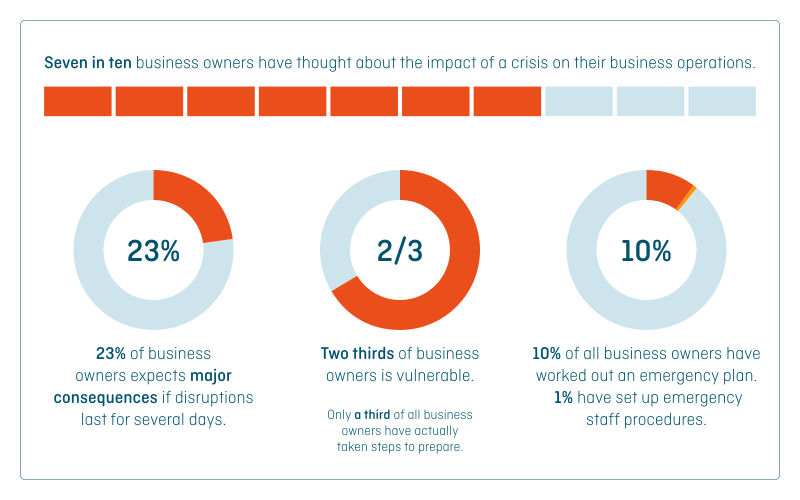
Business owners are aware of the risks but are not yet taking the right action.
- 7 in 10 business owners have thought about what a crisis would mean for their business operations.
- Almost a quarter of business owners expect major consequences if disruptions last for several days.
- Two-thirds of business owners are vulnerable. However, only one-third of business owners have actually taken measures.
- Emergency planning and emergency protocols for staff are hardly ever in place.
Source: KVK Weerbaarheid van ondernemers report (PDF, in Dutch).
Critical processes – you cannot operate without these
Without these processes, your business cannot operate or remain open. For example, because it is unsafe for your staff or customers.
3 examples:
- Cooling/temperature control at an ice cream shop – if the temperature rises, the ice cream is no longer safe, and you must close immediately.
- Security systems (alarm system, CCTV, emergency lighting) at a concert – without these systems, you cannot safely accommodate or evacuate the audience.
- Production that must not be interrupted, such as at a bakery – if the baking process stops, the product is ruined and you must throw it away.
Characteristics of critical processes are:
- the location cannot be visited, or cannot be visited safely
- staff cannot work, or cannot work safely
- customers cannot pay, or cannot pay safely
- the product cannot be produced, or cannot be produced safely
Important processes – you can manage without these for up to 72 hours
These processes can be briefly interrupted, but it is important to resolve the issue as quickly as possible.
5 examples:
- payments and invoicing – a temporary delay is possible, but without income your business is quickly at risk.
- access to systems – staff cannot do their jobs properly if systems are unavailable.
- customer service – customers expect a prompt response; without it you risk reputational damage.
- administration – this can wait for a while but must be updated in good time so that you can keep an overview and meet your obligations on time.
- stock management – without up-to-date insight, you may misjudge stock levels and miss out on turnover.
Characteristics of important processes are:
- your business is not immediately in crisis without these processes
- without these processes, you do face immediate risks, such as loss of turnover or damage to your reputation
Other processes – not time-sensitive
Your business or production is not at risk without these processes.
Examples include:
- marketing – campaigns can be temporarily paused without causing immediate disruption to your business operations.
- planning – appointments and schedules can be updated later without work coming to a standstill.
- reporting – analyses and overviews are important, but not urgent in an emergency.
Identify your top 3 most critical business processes
Determine which business processes are most important to your business. Without those processes you cannot run your business, or cannot do so safely. With this insight, you can create back-ups or emergency plans.
An example: you run a car wash. You rely on the water supply to provide your services. Without water, the car wash simply cannot operate. The car wash also needs lighting and safety sensors. These rely on electricity and use cameras, amongst other things. Without these systems, it could be unsafe for customers or staff. And customers need to be able to pay for a wash programme. You rely on IT systems for this.
The top 3 most important processes are:
- Water supply. No backup is possible. Determines whether or not the business is open.
- Safety lighting and cameras. Emergency lighting may be an option. Check with the car wash supplier.
- IT systems. Sales and payments may be possible via an offline mode or in cash. Discuss with the till system supplier.
| Critical processes -criteria in the event of a failure | Can your premises open safely? | Can you safely receive customers? | Can you safely operate? |
|---|---|---|---|
| Payments | Yes | Yes | Yes |
| Production | Yes | Yes | No |
| Website / online shop | Yes | Yes | Yes |
| Water supply | No | No | No |
| Customer contact | Yes | Yes | Yes |
| Cooling/temperature control | Nee | Yes | No |
| IT-systems | No | No | No |
| Security system | No | No | No |
| Logistics | Yes | Yes | Yes |
| Stock management Yes | Yes | Yes | Yes |